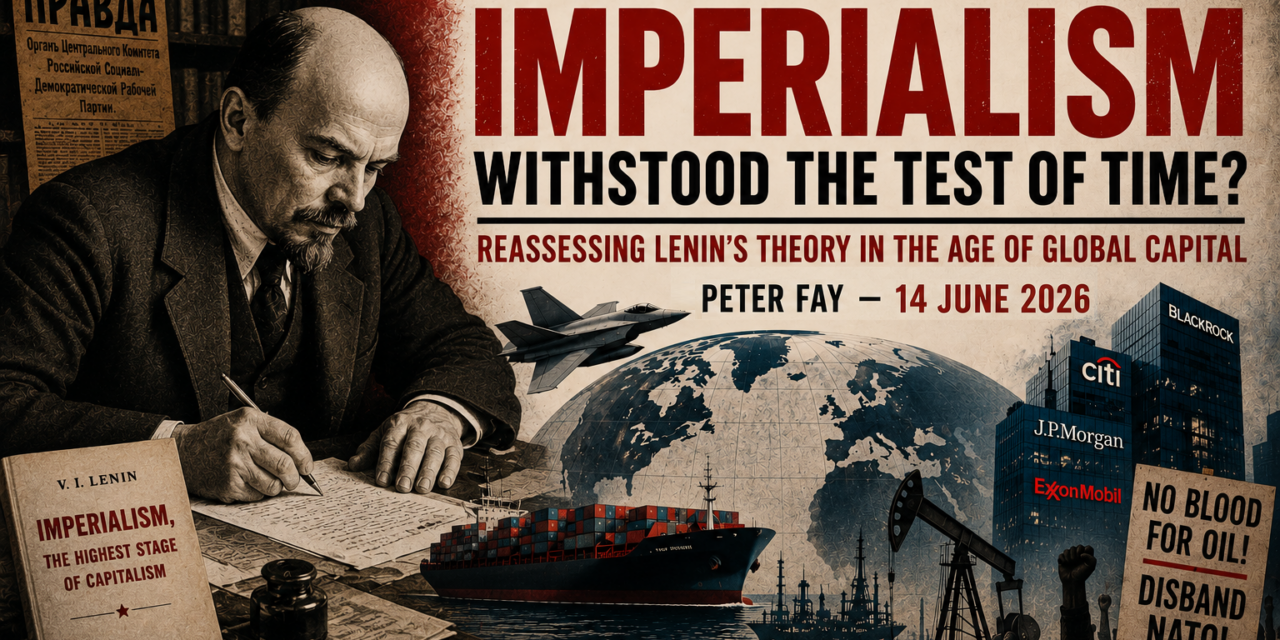
Has Lenin’s Imperialism Withstood the Test of Time?
Reassessing Lenin’s Theory in the Age of Global Capital
Peter Fay – 14 June 2026
Few political works have shaped anti-colonial and revolutionary movements more profoundly than Vladimir Lenin’s Imperialism, the Highest Stage of Capitalism (1916). Written amid the collapse of the Second International and the support of many socialist parties for World War I, it condemned both monopoly capital and the social-democratic movements that accommodated it.
More than a century later, the world has changed dramatically. Yet the work’s concepts of monopoly capital, colonial exploitation, labor aristocracies, and the parasitic tendencies of advanced capitalism remain a cornerstone of Marxist critique of empire and liberation.
Did Lenin’s work anticipate the changing forms of imperialism across the eras of decolonization, American hegemony, the Cold War, the collapse of the Soviet Union, and the emergence of a multipolar order? Can his theory still explain today’s dynamics of global capitalism and imperial rivalry?
This presentation examines both the enduring insights and some shortcomings of Lenin’s theory, assessing how best to apply those concepts to understanding capitalism today.
________________
Peter Fay is a public historian writing on slavery and early labor movements from a Marxist perspective. He also teaches Marx’s Capital using insights from his earlier experience as a United Steelworkers local officer, and an organizer with UE and District 1199.